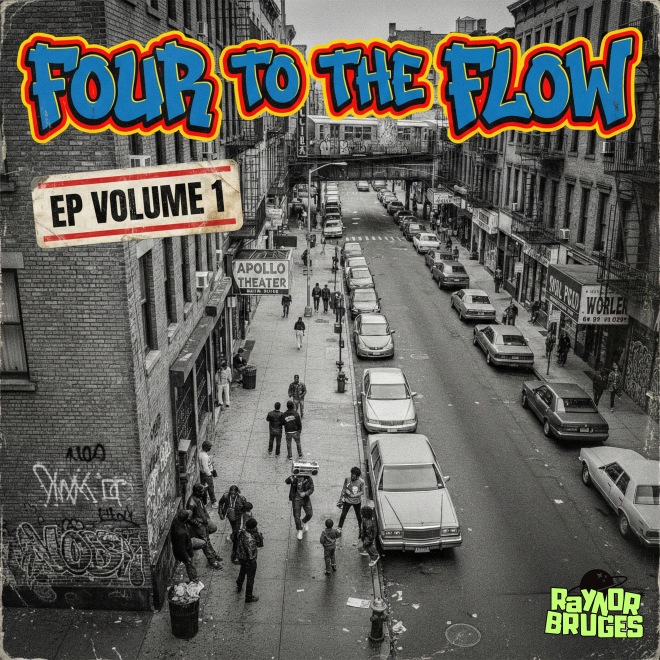


Raynor Bruges: Four to the flow

There is a particular kind of honesty that only appears after success.
Not the glossy kind. Not the press-shot, bio-approved narrative. The quieter one. The moment when someone admits that what worked did not feel right.
Raynor Bruges does not dramatize his story. He does not romanticize it either. If anything, he reduces it to a few simple truths. He was alone a lot. Music filled the room. Later, when the rooms became full, something inside him felt empty again.
Four to the Flow is not a genre experiment. It is the sound of that realization.
He grew up as an only child with a teenage single mother. That detail matters less as trauma and more as atmosphere. There was time. A lot of it. Hours spent behind a screen. Burning CDs. Recording radio shows onto cassette tapes. Watching MTV, TMF, The Box. Downloading tracks before algorithms knew what to recommend. His education in House came from proximity. His mother’s 90s collection. His aunt’s Club iT compilations. Music was not discovery through curation. It was inheritance.
Later, isolation returned in a different form. Depression has a way of shrinking the world back down to one room. Instead of resisting it, he built inside it. A MIDI controller. A cracked version of FL Studio. A year spent almost entirely indoors, leaving only for groceries.
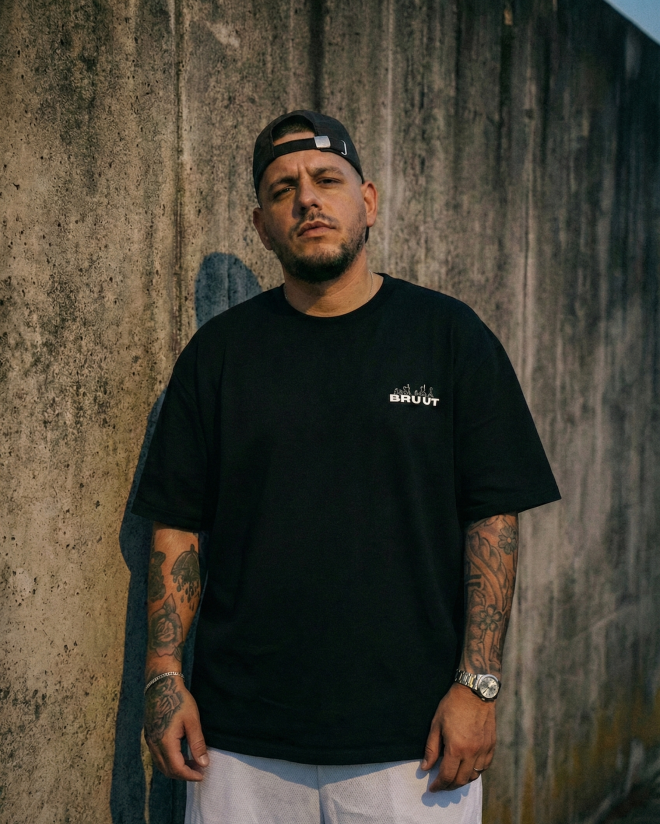
“I bought a MIDI controller to fight through a depression. That 4/4 rhythm was my safe space.”
There is something unglamorous about that image. No neon lights. No club. Just a kick drum repeating into the night. But that repetition did something. It stabilized him. House music, in its most mechanical sense, offered structure when everything else felt unstable. The grid became a kind of spine.
When he stepped into DJing professionally, he carried that relationship with him. But the market had its own gravity. Bruges discovered quickly that he had an instinct most DJs either learn too late or never develop: he could read a room. Not in a superficial way, not just tempo or genre preference. He could sense when energy needed to pivot.
If a Hip Hop DJ would work better than him in that moment, he stepped aside mid-set. He let someone else take over.
That decision says more about him than any booking ever could.
Eventually, he stopped stepping aside and decided to absorb it instead. If the crowd needed Urban energy, he would deliver it himself. He mastered Hip Hop and R&B with the same discipline he once applied to House. The result was momentum. Residencies with major Dutch brands. Up to 150 shows a year. Packed rooms. Recognition.
From the outside, it looked like arrival.
“I often felt like a high-end jukebox.”
It is a brutal sentence. Because it acknowledges something most DJs will not say out loud. There is a difference between control and authorship. Between playing what people want and building something they did not know they needed.
At the same time, he was working behind the scenes as a Talent Buyer for ID&T, curating stages at Sensation and Mysteryland. From that vantage point, the industry reveals its mechanics. Trends are loud but temporary. Careers are quieter but persistent. The artists who last are not necessarily the most hyped. They are the most aligned.
“It is the entertainment business. But if you focus too much on the business, you lose the art.”
That sentence carries weight when spoken by someone who has stood on both sides of the barricade.
Four to the Flow is what happens when alignment wins over comfort.
The title feels simple until you sit with it. Four. The architecture of House. Flow. The cadence of rap. Two rhythmic systems that historically intersected but culturally drifted apart. Bruges does not treat their separation as musical. He calls it political. Image-based. Industry-shaped.
“The dancefloor is already moving faster than the industry.”
Listen closely and the EP does not sound like a mash-up. It sounds integrated. That integration is technical as much as emotional. Hip Hop prioritizes bars, density, narrative propulsion. Tech House uses vocals as texture, as percussive suggestion. Too many words suffocate a groove. Too little grit dissolves identity.
“My natural tendency is to overdo it. But in the club, less is more.”
Restraint became the discipline.
His production method borders on obsessive. Instead of sampling old Boom Bap records, he builds his own. Full original tracks at 94 to 96 BPM. Then he dismantles them. Stem-splits. Resamples. Fragments. Rebuilds the pieces inside a Tech House framework at club tempo. Vintage emulations for texture. Saturation for memory. He becomes both producer and crate-digger of his own material.
The result feels excavated from the 90s, but it is entirely new.
When he says, “The Tech House beat that saved me is driving the Urban flow that built my career,” it does not sound like branding. It sounds like integration. The kid recording radio shows. The DJ navigating market demand. The curator analyzing long-term strategy whilst still reading every room he plays at. They are no longer separate identities negotiating control.
They are synchronized.
The decision to leave a successful Urban career was not cinematic. It was cumulative. Show after show, he found himself wishing he was playing Tech House instead. Applause without alignment becomes noise.
“With House music, I can take the audience on a journey they didn’t know they wanted.”
That is the difference. Hits satisfy. Journeys transform.
He often references Rick Rubin’s philosophy of creating from the purest version of self. It is easy to quote that idea. It is harder to apply it when bookings are stable and income is predictable. Four to the Flow feels like the moment he stopped negotiating with himself.
He even opened the process to his audience, letting them vote on tracks, inviting them into unfinished stages. For some artists, that would signal insecurity. For him, it signals abundance.
“Sharing multiplies.”
There is no grand manifesto attached to this EP. No attempt to declare a new movement. If anything, its power lies in its refusal to overstate itself. It is not a comeback. It is not reinvention. It is consolidation.
Hip Hop and House are not phases in his career. They are the two halves of his instinct. Four to the Flow does not try to impress. It tries to align.
And alignment, in dance music, is everything.
At 128 BPM, you can hear the difference between someone playing a role and someone standing in their own rhythm.
Raynor Bruges, finally, sounds like the latter.