


Merimell: Building The Scene She Needed

Fifteen years ago, Merimell was not looking at an established Estonian techno circuit and wondering how she could become part of it. There was barely a circuit to enter. She played bars, small clubs, birthday parties and whatever else would put her behind a pair of decks, moving between genres because opportunities to play techno simply were not there. Eventually, instead of waiting for the scene around her to change, she started building the spaces she wanted to play herself.
“When I started, there were basically no techno events in Estonia, so I played every genre possible. I played in every bar, small clubs and did sets at birthday parties, because I just wanted to play. As my name got around and people heard my music, I started saving money from the bar gigs to create my own techno events.”
That decision became Machine Nation, although its beginnings were considerably smaller than the warehouse raves it produces today. Merimell remembers the first event pulling approximately five people; now, Machine Nation can bring more than 1,000 into a three-floor warehouse. The progression took years rather than arriving through one breakthrough moment, and that slow construction has become fundamental to how she understands her career.
“Because the techno scene in Estonia was so small, it took me all these years to build it to where it is today. Now I’m finally at a point where I have successful events and I’m getting booked every weekend, which means I can play the music I truly love, hard techno.”

FROM ESTONIA OUTWARD
Her international movement began surprisingly early. Once Merimell started releasing her own productions, the distance between Estonia and the wider European circuit suddenly became smaller. Her first ghetto house vinyl led almost immediately to a booking at Nouveau Casino in Paris, while support from Richie Hawtin, Dubfire and other established names pushed her music into circles far beyond home.
“I remember the day I released my first ghetto house vinyl, and almost straight away I got booked to play at Nouveau Casino in Paris. The release was also getting played by Richie Hawtin, Dubfire, and a lot of other big names at the time, which obviously helped a lot.”
There was another element developing alongside those releases: showing up. Merimell booked artists she respected for her own events, but she also travelled to support friends when they played abroad. Those trips became opportunities to understand how other promoters built their events, how different DJs approached rooms and how communities outside Estonia operated.
“You go to your friends’ events, especially when they’re playing abroad, you support them, and at the same time you get to experience how other people do their events and hear different DJs play. It gives you a wider perspective and helps you understand how you can make your own events better. And of course, people remember when you show up for them and wanna support you back.”
That mentality has gradually carried her from Estonia into spaces including Tresor and festival stages in Colombia. Underneath the geographical expansion, however, her musical instinct has remained direct: Merimell likes things hard, fast and physical. Her first DJ set was actually hardstyle, long before the current collision between hard techno and harder styles became such a visible part of European dancefloors.
A later encounter with Dr. Motte at Freedom Parade in Tartu pulled her deeper into techno. Today, her sets bring that history full circle, moving through hard techno while bringing hardstyle, uptempo and rawstyle back into the picture. For Merimell, it is less about maintaining genre purity than keeping the energy exciting enough that she still wants to hear what comes next.
“Now, in a way, I’ve come back to my roots. I play hard techno and mix in a lot of hardstyle, uptempo and rawstyle. I just love the energy of it, fast and uplifting melodies, it being intense and fast! It keeps the music interesting for me.”
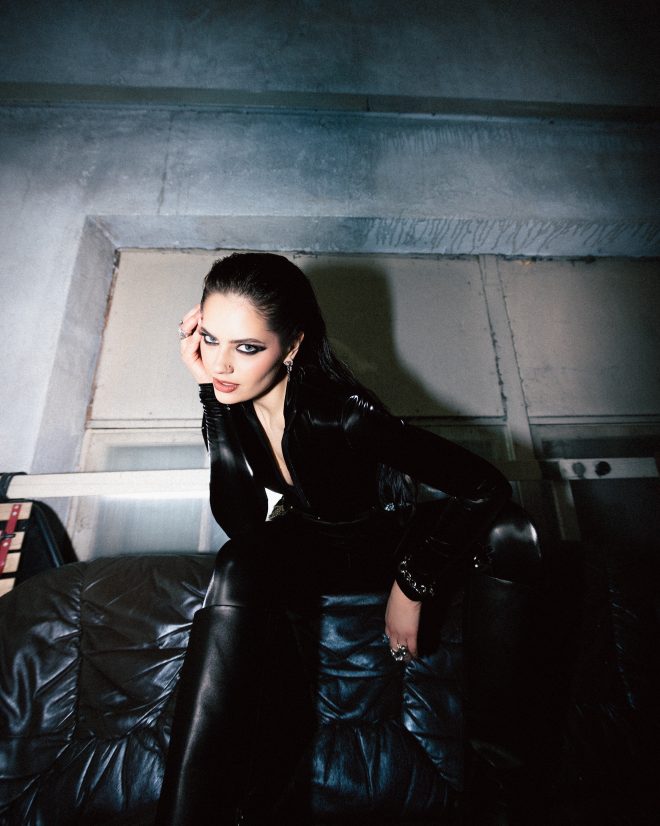
BUILDING MACHINE NATION
Machine Nation actually began with radio. Merimell was approached by the programme manager of Estonia’s national station Raadio 2 after he heard her play, eventually hosting the Machine Nation radio show for eight years. The programme gave her room to explore different corners of techno without having to think exclusively about what worked in a club.
It also gave her a platform she could share. Interviews, podcasts, rooftop livestreams and event shout-outs turned the programme into something larger than Merimell simply presenting her own selections. At a time when Estonia’s underground remained relatively small, radio became another way of making the people within it visible.
“Because I hosted the show for so long, it also gave me the opportunity to give a platform to other DJs who maybe weren’t getting as much visibility on the scene. We did interviews, turned some of the episodes into podcasts, hosted livestreams on the radio’s roof, and shouted out each other’s events. It became more than just a radio show — it became a community and gave our underground more visibility.”
The physical Machine Nation parties grew from the same instinct. Merimell wanted control over the lineups and the freedom to build something that reflected what she felt was missing around her. Small clubs became larger venues, and those venues eventually became a three-stage warehouse rave that now reaches beyond techno into house and drum ‘n’ bass.
“I respect music as a whole and I find it very important to include everybody. My next goal is to take it even further, to build an outdoor festival and eventually, do it in an arena.”

BEDROOM MUSIC
For all that expansion, Merimell’s production process remains almost aggressively uncomplicated. Talk of studios makes her laugh because there is no expensive room full of hardware behind the records. There is a bedroom, laptop, headphones and usually some emotion she needs to get out.
“It’s always so cute when people talk about producing in a studio, because for me, it’s still just me sitting in my bedroom with my laptop and headphones. When I make music, I usually just sit down and start exploring sounds. There’s almost always some kind of feeling behind it, something that happened in my life, a certain moment, or an experience that really stayed with me.”
That emotional immediacy sits underneath two releases arriving this October. “At Night”, landing through Charlie Sparks’ label on October 2, came after a long period without what Merimell considered a proper gig. When a booking in Barcelona finally arrived, the relief followed her all the way home.
“Then I finally got booked in Barcelona, and after the show I was just so happy and grateful that it had finally happened. I came home and made that track same night.”
The Verknipt release arriving October 16 came from a much more uncertain place. Merimell had not produced for some time and was struggling for inspiration when she attended a Verknipt event in Amsterdam. The scale of what she experienced left her inspired, but also wondering whether she could ever reach it herself.
“I came home thinking, ‘I’m never gonna make it.’ That was actually the original title of the track. But when Verknipt wanted to release it, I changed the name to ‘Made for This’, because in the end, that’s what I felt I was.”
The title change feels particularly fitting for somebody whose career has largely been built through persistence. There was no ready-made techno infrastructure waiting for Merimell in Estonia, just as there was no guarantee that five people at an early Machine Nation party would eventually become more than a thousand. She continued anyway.
INTO ADE
That next chapter brings Merimell to Amsterdam Dance Event for the first time this October, including a B2B with Charlie Sparks on October 21. Despite their connection through her upcoming release, the pairing is not built around years of playing together or some carefully rehearsed musical formula. In fact, neither really knows what the other is going to play.
“We didn’t really have any musical connection before that, we’re not even sure what the other person is going to play. But I think that’s actually the best part of it. We just show up, read the room, feel each other’s energy, and build something together in the moment.”
For Merimell, that uncertainty gets close to what DJing should be. Rather than arriving with every transition predetermined, the challenge is to listen, react and find the shared language while people are already standing in front of you. It turns the B2B into a genuine exchange rather than two individual sets stitched together.
ADE itself represents something broader. Merimell wants to attend panels, meet people, hear music and absorb as much of the week as possible while her own releases begin another international push. After spending 15 years building outward from Estonia, she is entering this period with a remarkably simple idea of what success should allow her to keep doing.
“I’m really excited about the future, releasing new music on my favorite labels, playing at as many events and in as many cities around the world as possible, and just traveling, experiencing new things, and enjoying every moment of it.”
The rooms may be bigger now, but Merimell has not tried to erase the small beginnings that got her into them. Machine Nation can fill a warehouse while she still makes music on headphones in her bedroom, and international bookings coexist with the same instinct that once made her play birthday parties simply because she wanted to DJ. Her motto strips the entire journey back to exactly that.
“Make music, travel the world and meet new people! That’s what life is about for me.”
